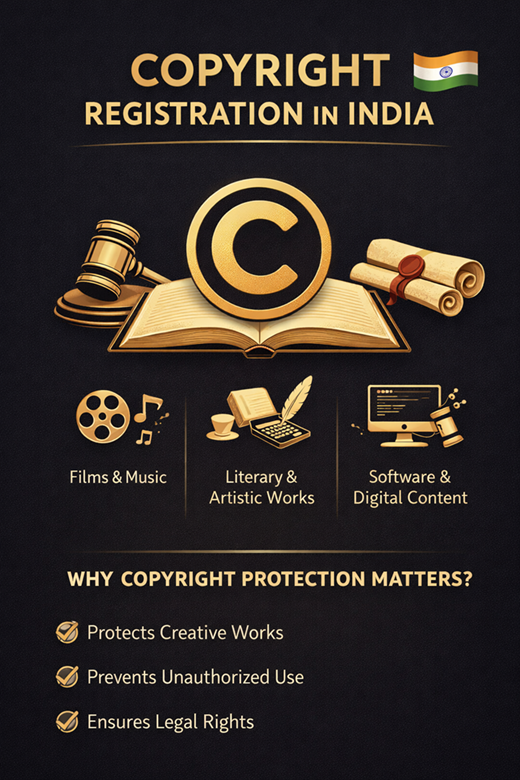
Introduction: Why Copyright Protection Matters?
Copyright, a legal entitlement vesting in the creator, is
the exclusive control over the use, reproduction, and commercial exploitation
of their original work. The Copyright Act, 1957 (Copyright Act) and the
Copyright Rules 2013 (Copyright Rules) together form the governing laws of
copyright protection in India. Copyright law is to protect the fruits of a
man’s work, labour, and skill from
annexation by other people.[1]
It is a bundle of exclusive rights to protect the produce of a person’s skill
and labour. The right is limited in time, i.e., the life of the author and
sixty years after their death[2]
and upon expiration thereof, the work enters the public domain, becoming freely
accessible to the general public without any restrictions.
What Can Be Copyrighted?
The Copyright Act protects all original works, including but
not limited to computer programmes, dramatic works, literary works, musical
works, artistic works, cinematograph films and sound recordings.[3]
An original work does not require novelty or inventive thought. It must simply
originate from the author and should not be copied from another source.
Derivative and adaptive works are also protected under the Act, provided they
involve sufficient skill, labour, and independent input.
The Supreme Court of India has clarified that while a
minimal degree of creativity is required to claim copyright, the work need not
be novel or non-obvious. However, it must demonstrate a substantial variation
and not merely a trivial or mechanical difference.[4]
Registration of Copyright
Registration offers an official public record that confirms
the creator’s rights. This record serves as prima facie evidence of ownership
in the event of unauthorized use. Registration gives the creator exclusive
rights to the work. These rights include control over distribution,
reproduction, exploitation, display, and performance.
Publicly accessible register of copyrights informs third
parties about the owner of a work, therefore lowering the chances of
unintentional infringement. In fact, a cease-and-desist notice accompanied by a
registered copyright is given more weight and results in early settlements. A
creator can also effectively commercialize their work by licensing, sale or
franchising negotiations with a registered copyright.
Registration Process[5]
Sections 44 to 50A of the Copyright Act deal with
registration. The application may be filed online through the Copyright
Office’s e-filing portal or by mail.
Step 1: Preparing the Application (Form XIV)
The Application must be filed through Form XIV, by
accurately filing in the required information, including the applicant’s full
name, residence, nationality, work title, description, date of publication (if
available), details about the creator and co-owners, if any, along with a declaration
of ownership to the work.
Step 2: Documents to be Filed
Together with Form XIV, applicants must submit supporting
documents, including two copies of the work, with the prescribed fee. An
application signed by the applicant[6],
and an NOC, if the applicant is not the author, or if the work is published and
the publisher is different from the author. When filed through an attorney, a Power
of Attorney needs to be enclosed with it. If the author is deceased, then an
NOC from the legal heirs must be provided.
If an artistic work is used or will be used on goods as a trademark,
a search certificate from the TM office must be submitted. Further, if a
photograph or any identifiable likeness of a person appears in a work, an NOC
must be obtained from that person. In case of cinematograph films and sound
recordings, NOCs from all the copyright holders or a copy of the assignment
deed are to be filed. Two copies of the musical work in MP3 format, along with
the graphical notation or the sheet music, must be submitted. For computer
programs, the applicant should provide the source and the object code to verify
the work.
Step 3: Examination and Objection
The Copyright Office undertakes a thorough review of each
application and may raise objections upon identifying any errors or
inconsistencies, providing the applicant
an opportunity to respond within a prescribed period, usually 30 days.
Step 4: Registration and Issuance of the Certificate
If the application is found to be in order and does not
contain any discrepancies, the information of the application will be published
in the Copyright Journal, so offering the public a fair chance to raise any
objections to such registration. In this period, disagreements over ownership
or pre-existing copyright may be brought up. If no oppositions are made after
publication, the registration will be processed, the Copyright Registration Certificate will
be issued, and the work will be entered in the Register of Copyrights. This
certificate is accepted as a proof of ownership and rights in the work in
courts.
Conclusion:
Registering your copyright not only strengthens your legal
position but also acts as a deterrent against unauthorized use. In a landscape
where creative work is constantly shared and reused, taking this step ensures
that your rights remain protected and easily enforceable. If you have created
something valuable, it is worth asking, “Have you taken the necessary steps
to protect it”? A simple registration today can help you avoid complex
disputes tomorrow.
[1] Sulamangalam
R. Jayalakshmi v. Meta Musicals, Chennai, 2000 PTC 681
[2] Section 22, Copyright Act, 1958
[3] Section 13 (1), Copyright Act
[4] Eastern Book Company v. D.B.
Modak, (2008)
[5] https://www.khuranaandkhurana.com/2024/12/23/registration-process-for-copyright-in-india
[6] Rule 70 (3), Copyright Rules, 2013